Location: Walkerton, Hanover, Chesley and Paisley, Ontario
Lead Organization: Trinity Theatre
Community Leaders: Shirley Richardson, Walkerton; Lynda Brink, Hanover; Janice McGuire, Chesley; Sandra Crockard, Paisley
Focus: Intergenerational storytelling, shared learning and community connection
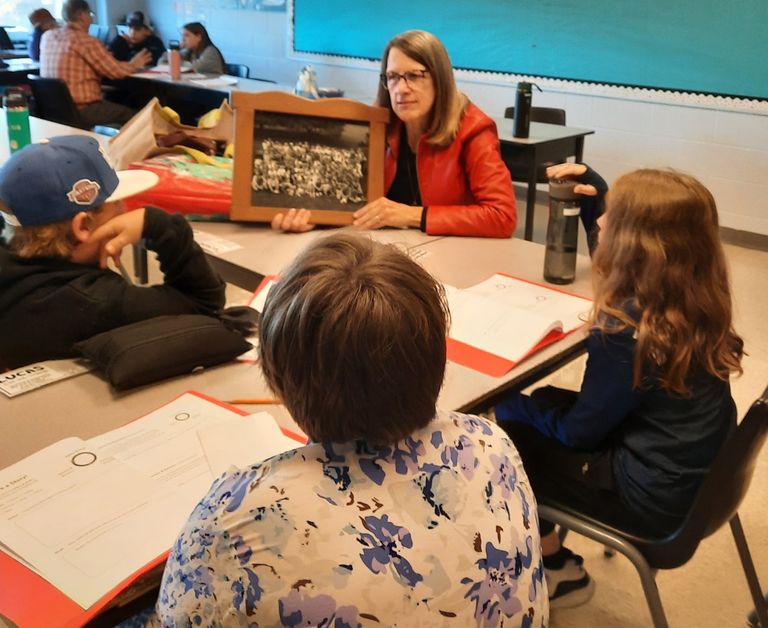
“You have to believe in serendipity.”
That is how Sandra Crockard describes finding GrandPals.
Sandra was attending a meeting at Chesley District Community School when someone mentioned a program connecting older adults and students. Later that same day, at an entirely different community meeting in Paisley, GrandPals came up again.
Twice in one day.
She went online, learned more, and then brought the idea to the local school.
By that point, something had already begun spreading across the region. Shirley Richardson had first brought GrandPals to Walkerton. From there, Lynda Brink helped establish the program in Hanover. Janice McGuire stepped forward as a local leader in Chesley. Sandra would become the champion for Paisley.
Today, those four communities are beginning to operate not simply as individual GrandPals programs, but as a growing regional network.
And the way it happened may offer an important lesson for other communities.
There was no grand expansion plan. One person told another. One teacher became interested. One volunteer had a good experience and told a friend. One community leader saw what was happening in a neighbouring town and wondered whether it could happen in their own.
“GrandPals travelled through relationships.”
It Started With One Conversation
For Shirley, the story began with a friend from another community who was already a GrandPal.
Her friend talked about the experience with such enthusiasm that Shirley became curious. She looked up the program and contacted GrandPals to learn more. Shirley then approached the Bluewater District School Board to get clearance before bringing the idea to the principal at the Walkerton school.
From there, things began to grow. A conversation at a hockey arena later helped open the door to Hanover, connecting Shirley with a Grade 5 and 6 teacher who was interested in trying the program there.
“Word of mouth. One person telling the next person who got excited.”
Teachers became interested. Principals saw what was happening. GrandPals told other older adults.
And perhaps most importantly, people were able to see the relationships for themselves.
Lynda remembers one teacher from another school who happened to be sitting in the library during a GrandPals Meet and Greet. He was not there for the program. He was simply waiting for another meeting.
But he watched.
At the end of the session, he approached the GrandPals and told them how struck he was by what he had seen: students captivated by the older adults sitting with them, listening respectfully and completely engaged in conversations with people they had only just met.
Sometimes that is all it takes. Someone sees the possibility.
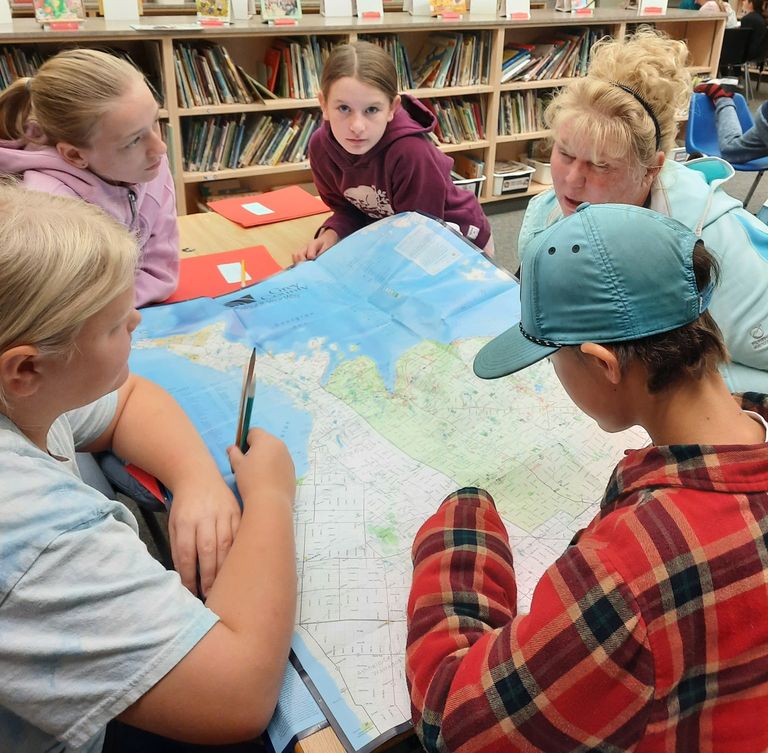
The Personal Invitation Matters
As GrandPals has grown across the region, the coordinators have learned that recruiting older adults is not primarily about advertising.
It is about invitation.
“People, seniors, really do want to make a difference in their community, and especially with children.”
Lynda says many older adults she speaks with are looking for meaningful ways to contribute. But wanting to contribute does not necessarily mean someone immediately sees themselves as a GrandPal.
That is where the local coordinator becomes important.
Sandra describes her own approach simply. She did not put out a broad call and wait to see who responded. She thought about people, then tapped them on the shoulder.
She looked for a diverse and interesting group of community members who she believed had something to offer young people. For some, that invitation carried an important message: You see something in me. You think I can do this.
That personal vote of confidence can be enough to move someone from uncertainty to participation. And after people participate once, recruitment begins to change. GrandPals start recruiting GrandPals.
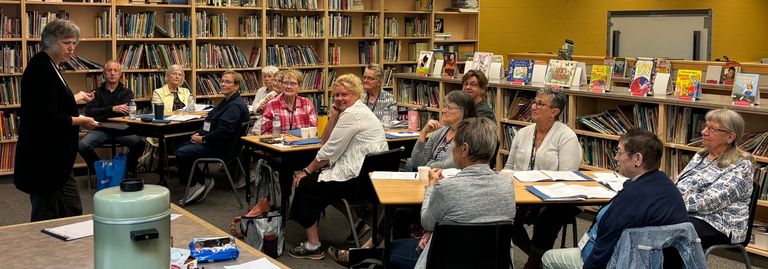
The Coordinator Is the Glue
Resources, orientation and program structure matter. But local coordinators provide something a resource cannot.
“I feel like I’m the glue.”
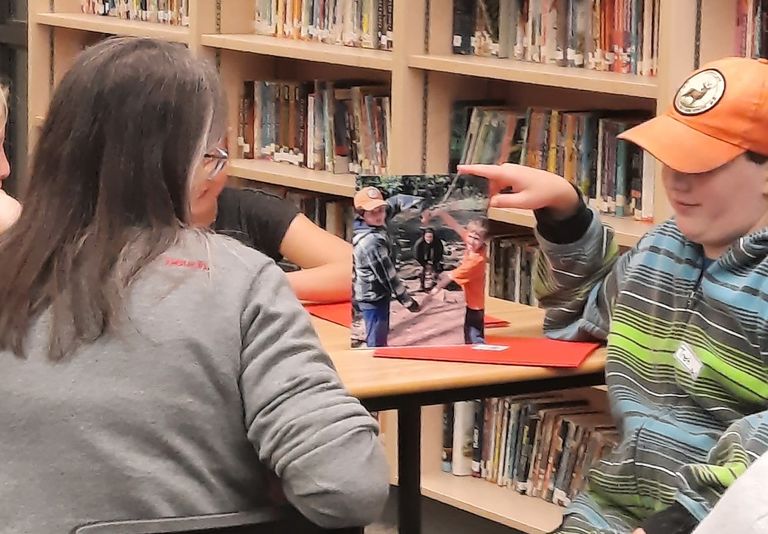
The coordinator is the familiar person who welcomes volunteers, helps them prepare, notices when someone is uncertain and reassures them that they can do this.
They are also there when something does not go exactly as planned.
Shirley remembers a session when one group of students was struggling to take turns. She walked over, handed them a pen and suggested they pretend it was a talking feather. Whoever held it had the floor.
A small intervention changed the conversation.
That kind of moment illustrates why local leadership matters. GrandPals are not simply handed materials and sent into a classroom. Someone knows them. Someone is watching. Someone is there to help.
The relationship can come full circle too.
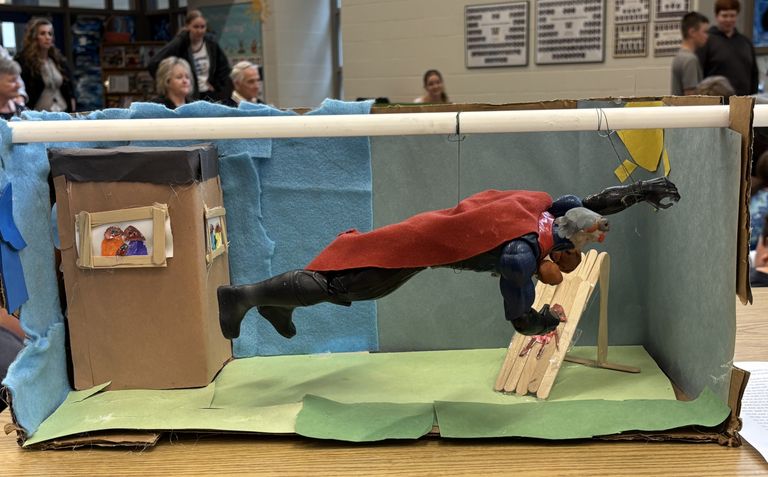
One day, while Lynda was covering for an absent GrandPal, she decided to turn the conversation back to the students. She asked them to imagine a day in the life of their regular GrandPal.
They quickly discovered how much they already knew about her: when she might wake up, what she ate and what she did during the day. But then their imagining went further.
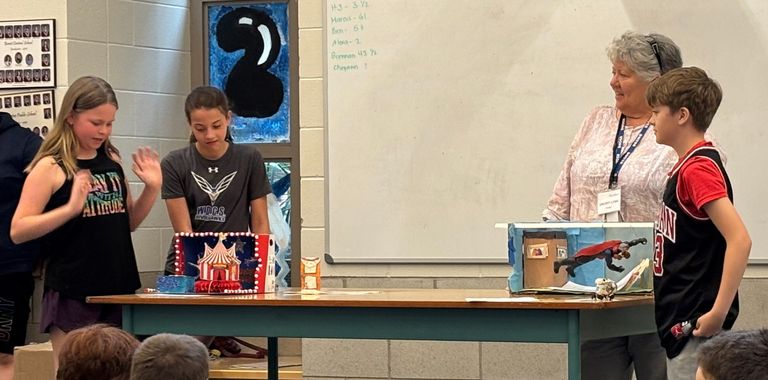
The students decided their GrandPal was a superhero who protected them from bullies and from bad things happening. One student chose the idea for his final presentation, creating a GrandPal who wore a cape, could fly and would swoop in to defend the students.
For Lynda, it was a striking glimpse of how deeply the relationship had taken hold. The GrandPal had come into the classroom hoping to make a difference in the students’ lives. In their own way, the students were showing just how much she had come to mean to them.
Finding an Organizational Home
As GrandPals expanded beyond a single community, another question emerged.
How do you support something that is becoming bigger than one person or one school?
Running programs requires resources. Materials need to be printed. Volunteers need support. Funding needs to be found. New schools need to be approached. Partnerships need to be maintained.
Shirley and Lynda had already demonstrated that local champions could make remarkable things happen. But continued growth required another layer of support.
That is where Trinity Theatre entered the story.
Based in Paisley, Trinity provides the regional initiative with an organizational home. It can pursue funding, support program expenses, build partnerships and create a structure around the work that individual volunteer coordinators would have difficulty carrying on their own.
“It’s a huge help to know that we have the funding now that we can go ahead and expand the program into more areas and not have to worry about that piece of the puzzle.”
For Shirley, that means being able to concentrate more fully on what she does best: supporting people and growing relationships.
Sandra also sees the potential for Trinity to connect GrandPals with relationships that already exist across the region, including schools, community organizations, service clubs and other partners.
The goal is not to replace local leadership. It is to make local leadership more sustainable.
Four Communities, Stronger Together
One of the most interesting things happening in Bluewater is that regional collaboration is not making the programs less local. It may actually be helping each community become stronger.
Lynda has noticed that most GrandPals want to volunteer close to home. Hanover residents generally want to participate in Hanover. Walkerton volunteers feel connected to Walkerton. The same is true in Chesley and Paisley.
Those local relationships matter.
At the same time, the coordinators do not need to operate in isolation.
They can share ideas. They can help one another with orientation. Experienced GrandPals from one cohort can encourage newcomers in another. Libraries may be able to provide meeting or orientation spaces. If one coordinator is unavailable, another familiar coordinator may be able to step in.
Shirley and Lynda have already supported one another across Walkerton and Hanover. Shirley has brought volunteers to Sandra’s orientation in Paisley. Now the four communities are beginning to think about what else might be possible together.
Perhaps GrandPals from several towns could occasionally gather and share stories. Perhaps orientations could be offered regionally. Perhaps coordinators could divide responsibilities, share resources and help one another when life inevitably gets complicated.
Sandra sees another important benefit. It makes the program less vulnerable.
Teachers change schools. Volunteers age. Coordinators encounter health challenges or family responsibilities. A program depending entirely on one person can disappear when that person is no longer available.
“A network can carry the work forward.”
The communities retain their own relationships and identities, while becoming part of something larger.
Momentum Changes What Is Possible
The word that came up near the end of our conversation was momentum.
Shirley is excited that another group of students will soon get the experience previous students have had. She hears from parents whose children participated in earlier programs and still talk about their GrandPals.
This year is particularly meaningful for her because her own grandson will be in Grade 5 and may have the opportunity to participate.
In Hanover, Lynda is preparing to launch another GrandPals program this fall and is facing the kind of challenge most coordinators would welcome.
“I’m hoping that I’m going to have too many GrandPals this year.”
Returning volunteers are coming back. New people are joining. Existing GrandPals are talking to their friends.
Sandra is looking outward, wondering which schools and communities might be next.
And somewhere in the middle of that conversation, Shirley once again used a phrase that has become familiar:
“We’re just getting started.”
After programs in four communities, countless volunteer hours, orientations, school sessions and student stories, it is an interesting thing to hear.
But perhaps she is right.
What Bluewater Can Teach Other Communities
The Bluewater story suggests that community growth does not have to begin with scale. It can begin with one person.
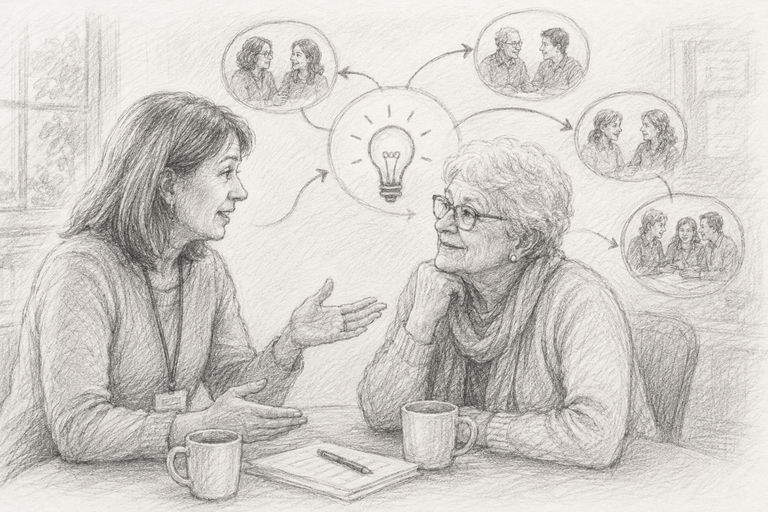
1. Start with someone who believes in it
Shirley heard about GrandPals from a friend. That was enough to begin. Community growth often starts not with a formal plan, but with one person who believes something meaningful could happen and shares that possibility with someone else.
2. Invite people personally
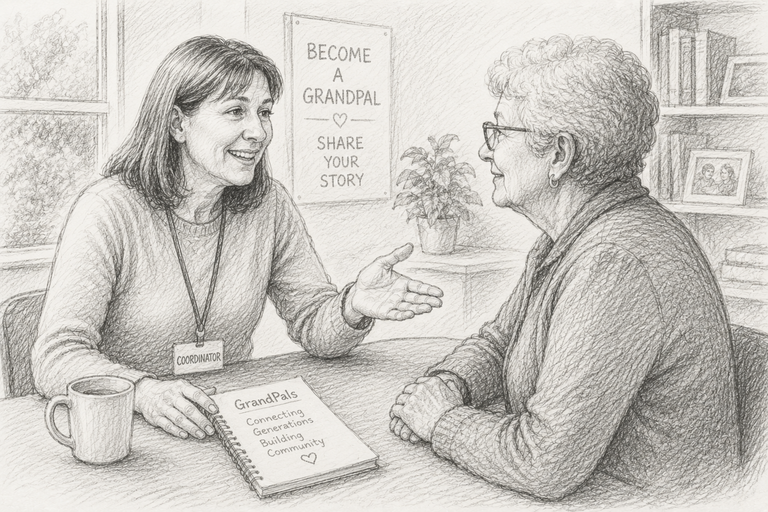
The strongest volunteers are often not waiting for a recruitment advertisement. In Bluewater, coordinators have found that a personal invitation — “I think you would be wonderful at this” — can be what helps someone see the contribution they have to make.
3. Give local leaders support
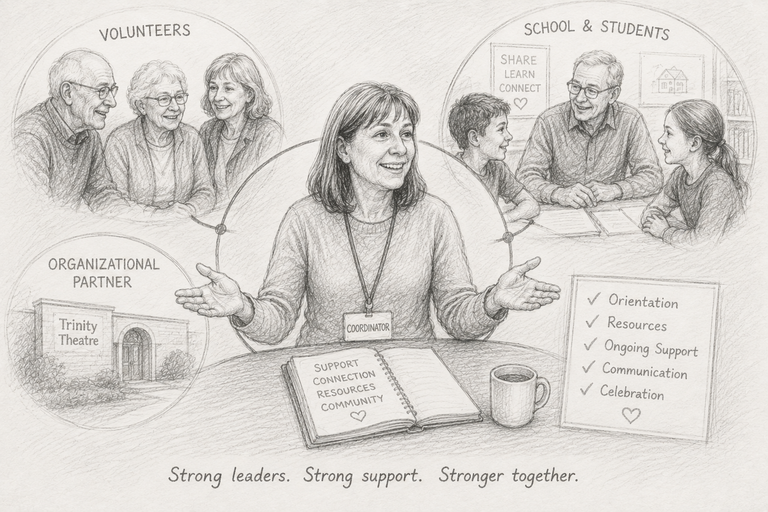
Coordinators make programs relational, responsive and human. But they should not have to carry everything alone. Volunteers, schools, program resources and an organizational partner such as Trinity Theatre can create the support around them that makes local leadership sustainable.
4. Let success travel
Teachers tell teachers. GrandPals tell friends. Parents talk about their children’s experiences. Neighbouring communities notice. What began in Walkerton moved outward through relationships to Hanover, Chesley and Paisley.
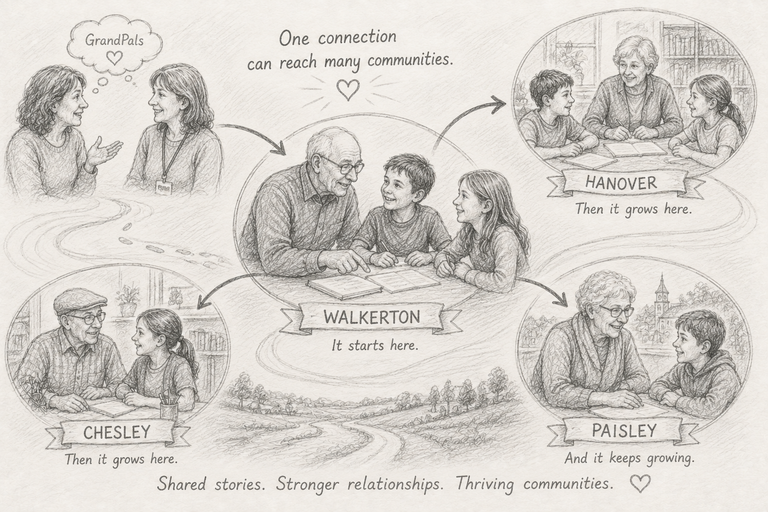
The four communities are beginning to look at one another not simply as places running the same program, but as people who can learn together, support one another and help the next community begin.
That may be the most important part of the Bluewater story.
“Community does not grow because an organization arrives and creates it. It grows when people begin to recognize what they can create together.”
And sometimes, it starts with one person telling another.
About GrandPals
GrandPals brings older adults and students together through storytelling, learning and friendship. Across Canada, schools, charities, municipalities, libraries, senior serving organizations and local volunteers are adapting the program to reflect the relationships and strengths of their own communities.
The Bluewater communities of Walkerton, Hanover, Chesley and Paisley demonstrate what becomes possible when strong local leadership is combined with regional collaboration and an organizational partner that can help good work grow.
Interested in exploring what GrandPals could look like in your community? Visit grandpals.app to start a conversation.